DSM PTSD Criteria: DSM-5-TR Symptoms, Time Frame, Codes, and CPTSD Context
Searching for DSM PTSD criteria can feel oddly technical when the real question is personal: "Do my reactions fit a known trauma pattern, and what should I do with that information?" The DSM-5-TR criteria for posttraumatic stress disorder describe a specific clinical pattern involving trauma exposure, intrusion, avoidance, changes in mood or beliefs, arousal changes, duration, distress or impairment, and rule-outs. They are useful as a map, but they are not a self-labeling shortcut. If you are also trying to understand complex trauma patterns, a gentle C-PTSD self-reflection tool can help you organize your experiences before deciding whether to speak with a qualified mental health professional.

What the DSM-5-TR PTSD Criteria Are Actually Checking
The DSM-5-TR places PTSD in the trauma- and stressor-related disorders category. In plain English, the criteria ask whether a person was exposed to a qualifying traumatic event and then developed a particular pattern of symptoms linked to that event. The symptom pattern is not just "feeling stressed" or having painful memories. It must include specific clusters and must last long enough, interfere enough, and not be better explained by substances, medication effects, another medical condition, or another mental health condition.
For adults, adolescents, and children older than six, the DSM PTSD criteria are usually summarized as eight parts: Criterion A through Criterion H. A clinician considers all of them together. Missing one required area can matter, even when the distress is real and deserving of support. This is one reason screening tools, checklists, and online explanations should be treated as educational starting points rather than final answers.
Criterion A: The Trauma Exposure Requirement
Criterion A is the gateway. PTSD in the DSM framework requires exposure to actual or threatened death, serious injury, or sexual violence. That exposure can happen directly, by witnessing the event in person, by learning that a violent or accidental event happened to a close family member or close friend, or through repeated work-related exposure to aversive details, such as some first responder roles.
This point often surprises people. Painful life events can be deeply disruptive without meeting Criterion A. A breakup, betrayal, job loss, invalidating family environment, or chronic emotional harm may still contribute to anxiety, depression, grief, attachment wounds, or complex trauma responses. The DSM PTSD criteria are narrower than the full range of human suffering.
That narrowness can be frustrating, but it also explains why "PTSD" and "trauma-related distress" are not identical terms. If you are trying to make sense of long-term relational trauma, it may help to look beyond Criterion A alone and consider whether the broader pattern looks more like PTSD, complex trauma, depression, anxiety, dissociation, or a mix that deserves careful professional assessment.
Criteria B Through E: The Four PTSD Symptom Clusters
After trauma exposure, the DSM-5-TR PTSD criteria look for symptoms across four clusters. Criterion B covers intrusion symptoms. These can include unwanted memories, trauma-related nightmares, flashback-like experiences, or intense emotional or physical reactions when reminded of the event.
Criterion C covers avoidance. This may mean avoiding thoughts, memories, or feelings connected to the trauma, or avoiding external reminders such as places, conversations, activities, people, objects, or situations. Avoidance can look quiet from the outside. A person may seem functional while carefully shaping life around what feels unsafe to remember.
Criterion D is one of the most searched parts of the DSM PTSD criteria because it covers negative changes in cognition and mood. This cluster can include trauma-related memory gaps, persistent negative beliefs about oneself or the world, distorted self-blame or other-blame, ongoing fear, guilt, shame, anger, reduced interest, detachment from others, or difficulty feeling positive emotions.
Criterion E covers arousal and reactivity changes. These may include sleep problems, irritability, angry outbursts, reckless or self-destructive behavior, concentration problems, hypervigilance, or an exaggerated startle response. The key is not whether a person has one hard week. The pattern needs to be connected to the traumatic event and present in the required combination.

PTSD DSM-5 Criteria Time Frame: More Than One Month
The DSM-5-TR time frame is one of the clearest distinctions: symptoms must last more than one month. Before that point, trauma-related symptoms may still be serious, but clinicians may consider acute stress disorder, acute stress reactions, adjustment-related concerns, grief, depression, anxiety, or other explanations depending on timing and symptom pattern.
"Acute vs chronic PTSD" is a common search phrase, but it can be misleading in DSM-5 and DSM-5-TR language. Older DSM frameworks used acute and chronic PTSD specifiers. DSM-5 removed those specifiers. Instead, DSM-5 and DSM-5-TR include specifiers such as dissociative symptoms and delayed expression. Delayed expression means the full criteria are not met until at least six months after the trauma, even though some symptoms may begin earlier.
So if you see a PTSD DSM-5 criteria acute vs chronic chart, check what system it is using. It may be discussing older DSM language, ICD-10-CM billing codes, informal clinical shorthand, or acute stress disorder rather than current DSM PTSD specifiers.
PTSD DSM-5 Code, PCL-5 Scores, and Clinical Assessment
Searches for "PTSD DSM-5 code" often lead to the code pair 309.81 and F43.10 in DSM-5-TR-oriented summaries. In real-world billing and records, coding can depend on jurisdiction, payer rules, and whether a system uses more specific ICD-10-CM options. For an article reader, the practical takeaway is simple: codes are administrative labels, not proof of a condition by themselves.
The PCL-5 is another common search result. It is a 20-item self-report checklist that tracks the DSM-5 PTSD symptom clusters and produces a total severity score from 0 to 80. It can be useful for screening, monitoring change, and organizing symptoms. However, interpretation depends on context, and a checklist score is not the same as a structured clinical interview.
The CAPS-5 is often described as a gold-standard clinician-administered PTSD assessment. It is a structured interview that can evaluate current or lifetime PTSD and requires training to use well. If you are comparing a PCL-5 PDF, a PTSD checklist, and DSM PTSD criteria, think of them as different layers: a checklist can organize self-report, the DSM describes the criteria framework, and a trained clinician can evaluate the full clinical picture.
For people whose questions are really about complex trauma patterns rather than a single DSM PTSD framework, a private CPTSD screening experience can be a softer way to reflect on symptoms such as emotional regulation, relationship strain, and negative self-concept before bringing concerns into therapy.

Complex PTSD and DSM-5 Criteria: Why CPTSD Is Different
Complex PTSD is one of the biggest sources of confusion around DSM PTSD criteria. In the DSM-5-TR, complex PTSD is not listed as a separate diagnosis. The DSM-5 expanded PTSD to include a broader range of negative mood and cognition symptoms, but it did not create a separate CPTSD category.
ICD-11, used internationally, does include complex PTSD as a paired diagnosis related to PTSD. In that framework, CPTSD includes the core PTSD pattern plus disturbances in self-organization: problems with affect regulation, a persistently negative self-concept, and difficulties in relationships or closeness. This is why someone may search "complex PTSD DSM-5 criteria" and find mixed answers. The concept is clinically important, but the official classification depends on whether the source is using DSM-5-TR, ICD-11, research language, or trauma-informed therapy language.
The difference matters because CPTSD conversations often involve prolonged, repeated, or interpersonal trauma, especially when escape or protection was limited. Still, ICD-11 does not require a particular trauma type for CPTSD, and prolonged trauma does not automatically mean CPTSD. A careful assessment looks at both exposure and symptom pattern.
A Practical Way to Read the Criteria Without Over-Labeling Yourself
If you are reading DSM PTSD criteria for yourself, try turning the criteria into gentle reflection questions rather than a verdict. What event or period are you connecting these symptoms to? Which symptoms feel intrusive, avoidant, mood-related, or arousal-related? How long have they been present? Are they affecting relationships, school, work, sleep, safety, or daily functioning? What else could be contributing?
This approach helps reduce two common mistakes. The first is minimizing: "It was not bad enough, so I should ignore it." The second is over-labeling: "I found a checklist, so the answer is settled." Both can make it harder to get appropriate support. Your experience can deserve care even when the label is uncertain.
If symptoms are intense, persistent, linked to safety concerns, or disrupting daily life, consider speaking with a licensed mental health professional. If you are supporting someone else, avoid assigning a label to them. You can offer care by listening, encouraging support, and respecting their pace.
Using DSM PTSD Criteria Alongside CPTSD Self-Reflection
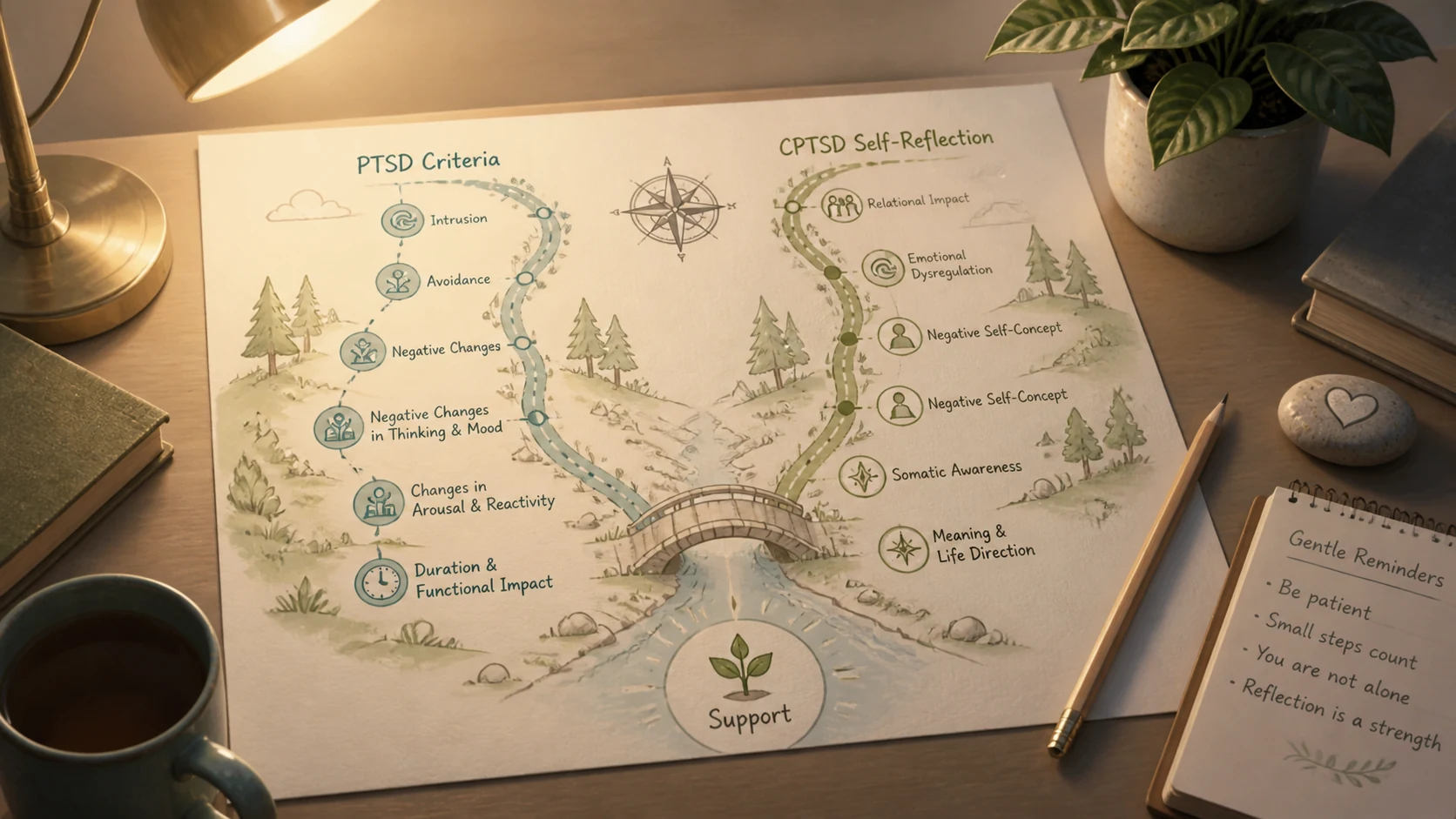
DSM PTSD criteria can help you understand the formal PTSD framework: qualifying trauma exposure, specific symptom clusters, duration beyond one month, distress or impairment, and clinical rule-outs. CPTSD self-reflection asks a slightly different but related question: do long-term trauma-related patterns show up in emotion regulation, self-image, relationships, and daily life?
For CPTSDTest.com readers, the most useful next step is not to force one label. It is to organize what you notice, keep the limits of screening in mind, and decide whether professional support would help you sort through the picture. You can use a trauma-informed CPTSD self-check as an educational starting point, then bring any concerns, patterns, or results to a qualified clinician if you want a fuller evaluation.
FAQ
What are the DSM-5-TR diagnostic criteria for PTSD?
The DSM-5-TR PTSD framework includes trauma exposure, intrusion symptoms, avoidance, negative changes in cognition and mood, arousal and reactivity changes, symptoms lasting more than one month, distress or impairment, and rule-outs for substances or other medical explanations. All required parts matter.
What is PTSD Criterion D?
Criterion D covers negative changes in thoughts and mood after trauma. Examples include persistent negative beliefs, distorted blame, ongoing fear, shame, guilt, anger, detachment, reduced interest, memory gaps related to the event, or difficulty feeling positive emotions.
Is there a DSM-5-TR code for PTSD?
Many DSM-5-TR-oriented summaries list PTSD as 309.81 with ICD-10-CM code F43.10. Coding can vary by system and purpose, so clinicians and billing professionals should follow the rules that apply in their setting.
Is complex PTSD in the DSM-5-TR?
No. Complex PTSD is not a separate DSM-5-TR diagnosis. It is included as a separate trauma-related diagnosis in ICD-11, where it includes core PTSD symptoms plus disturbances in self-organization.
What qualifies someone for a 70% disability rating for PTSD?
In the U.S. VA rating schedule, a 70% mental health rating involves occupational and social impairment with deficiencies in most areas, such as work, school, family relations, judgment, thinking, or mood. Benefits questions are legal and administrative matters, so veterans should use official VA guidance or qualified claims support.
What are the treatment guidelines for PTSD?
Current PTSD treatment guidelines commonly emphasize trauma-focused psychotherapies, such as cognitive processing therapy, prolonged exposure, trauma-focused CBT, and EMDR, with medication sometimes used depending on symptoms, preferences, and co-occurring conditions. Treatment choices should be made with a qualified professional.