CPTSD Test Results: Understanding Your Score & Next Steps
You've just completed a CPTSD screening test. Now, you’re looking at a score, but a new question arises: What do these numbers really mean for my life? It's common to feel a mix of confusion, validation, and uncertainty after receiving your results. You are not alone in wondering what to do next.
This article is your roadmap. We will guide you through understanding your CPTSD test results, helping you translate a score into meaningful, personal insights. We'll break down how scores are calculated, connect them to your daily experiences, and outline practical next steps for your healing journey. If you haven't yet taken a test, this guide will show you what to expect from the valuable insights you can gain. You can always begin your free test to get a clear, confidential starting point.
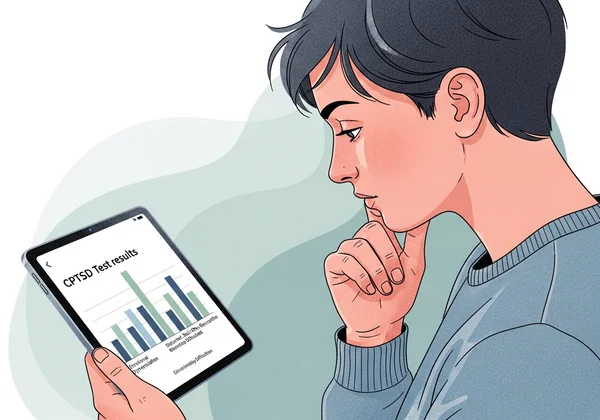
Before we begin, please remember this important disclaimer: This guide and the online test are educational tools, not a formal diagnosis. They are designed to provide clarity and empower you. For a professional diagnosis, please consult a qualified mental health professional.
Understanding Your CPTSD Test Results: What the Numbers Mean
Receiving a score is the first step, but understanding the science behind it builds confidence and clarity. Our screening tool is based on established clinical frameworks to ensure the results are relevant and helpful. This section will demystify the numbers and what they indicate about your symptoms.
The ITQ Framework: How Your Test Score is Calculated
Our test is based on the International Trauma Questionnaire (ITQ), which aligns with the World Health Organization's (WHO) ICD-11 guidelines for diagnosing Complex PTSD. This isn't just a random quiz; it’s a structured screening tool used by professionals worldwide.
Each of the 18 questions asks about experiences over the past month. You rate each item on a simple scale, often from 0 ("Not at all") to 4 ("Extremely"). Your total score is calculated by adding up these numbers. This final score reflects the overall severity of symptoms related to CPTSD.
Clinical Thresholds: What Your Score Indicates
Your score falls into a range that helps indicate the level of distress you may be experiencing. While every tool has slightly different scoring, they generally follow a similar pattern:
- Low Range: Suggests that you are likely not experiencing significant symptoms of CPTSD.
- Moderate Range: Indicates that you may be experiencing some symptoms that affect your daily life. This is often considered a subclinical level, meaning it causes distress but may not meet the full criteria for a diagnosis.
- High Range: A score in this range suggests that your symptoms are more severe and align closely with the clinical indicators for CPTSD. It strongly suggests that seeking professional support would be beneficial.
A higher score simply correlates with more frequent or intense symptoms. It is not a judgment of you or your character; it is a neutral measurement of your current struggle.
Beyond the Total Score: Symptom Domain Breakdown
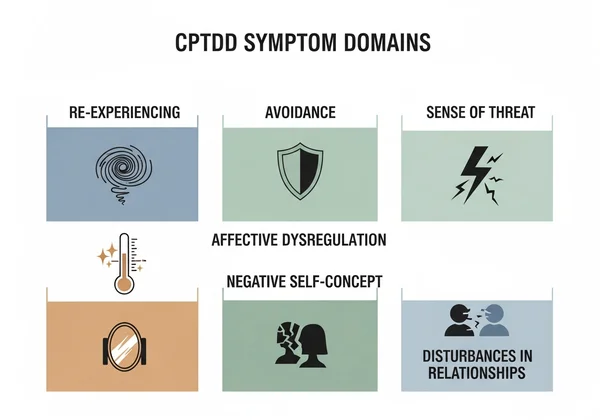
Complex PTSD is more than just one thing. The ICD-11 defines it by six core symptom domains, which our test helps to highlight. A good assessment, like the one offered on our site, doesn't just give you a total score. It breaks it down, showing you which areas are most challenging for you.
The six domains include:
- Re-experiencing: Intrusive memories, flashbacks, or nightmares.
- Avoidance: Actively avoiding reminders of the trauma.
- Sense of Threat: Feeling constantly on edge or easily startled.
- Affective Dysregulation: Difficulty managing emotions, such as sudden anger or sadness.
- Negative Self-Concept: Feelings of worthlessness, shame, or guilt.
- Disturbances in Relationships: Difficulty feeling close to others or maintaining relationships.
By looking at which domains have the highest scores, you can start to see a clearer picture of how CPTSD uniquely affects you. For example, someone might score highly in "Negative Self-Concept" but lower in "Re-experiencing," and this information is key to personalizing their healing.
Translating Your Results into Personal Insights
A number on a page means little until you connect it to your lived reality. This is the most empowering part of the process: turning data into self-understanding. This section will help you bridge the gap between your score and your day-to-day life.
Connecting Scores to Daily Life Experiences
Let’s make this practical. How do those symptom domains show up in real life? A high score in "Affective Dysregulation" might not just be a number; it might be the reason you feel overwhelmed by small frustrations at work or suddenly burst into tears without knowing why.
A high score in "Disturbances in Relationships" might explain why you push loved ones away, even when you crave connection, or why you find it impossible to trust new people. Seeing this connection can be a relief. It validates that your struggles are real and have a name, not just a personal failing.
For many, this is an "aha!" moment. As one user shared, "Seeing my high score in 'Negative Self-Concept' helped me realize my inner critic wasn't just 'me'—it was a symptom. That changed everything."
Identifying Your Personal Triggers & Patterns
Your test results are a map to your own patterns. Look at your responses. Do you notice that certain situations trigger a specific cluster of symptoms? Perhaps questions related to feeling on edge scored high, and you can now connect that to how you feel in crowded public spaces or during tense family gatherings.
Understanding these patterns is the first step to managing them. When you know that feeling unheard triggers a strong emotional response (Affective Dysregulation), you can prepare. You can develop strategies to ground yourself before, during, and after such situations. The goal is not to avoid life, but to navigate it with more awareness and tools. If you're ready to see your own patterns, you can start your assessment now.
Recognizing Your Strengths & Resilience Factors
Your test results do not define you. They are a snapshot in time. Importantly, they can also indirectly point to your strengths. Perhaps you scored lower in certain areas, which shows incredible resilience. Maybe your avoidance score is high because you have become an expert at creating a safe and stable environment for yourself.
Even challenging symptoms can reveal hidden strengths. A high sense of threat might mean you are incredibly perceptive and attuned to your surroundings. Difficulty with relationships might mean you are deeply loyal once you do let someone in. It’s crucial to view your results with self-compassion, acknowledging both the pain and the incredible strength it has taken to survive.
Creating Your Personalized Recovery Roadmap
Understanding your results is empowering, but true change comes from action. This is where you begin to build your personal trauma recovery roadmap. Your score is your starting point, not your destination.
When to Consider Professional Help
If your results fall into the moderate to high range, or if your symptoms cause significant distress in your daily life, it is a strong sign to consider professional help. A therapist specializing in trauma can provide a formal diagnosis and guide you through evidence-based treatments.
Look for therapists trained in modalities like:
- Eye Movement Desensitization and Reprocessing (EMDR)
- Somatic Experiencing (SE)
- Internal Family Systems (IFS)
- Trauma-Focused Cognitive Behavioral Therapy (TF-CBT)
Your test results can be an invaluable tool to bring to your first therapy session. They provide a concise summary of your struggles, helping you and your therapist get started more effectively.
Self-Help Strategies Based on Your Symptom Profile
Whether you seek therapy or not, there are many things you can do to support your own healing. You can tailor these strategies to your specific symptom profile.
- For high Affective Dysregulation: Practice grounding techniques. When you feel overwhelmed, focus on your five senses: name five things you can see, four you can touch, three you can hear, two you can smell, and one you can taste.
- For a high Negative Self-Concept: Start a self-compassion journal. Each day, write down one thing you did well or one kind thing you can say to yourself.
- For a high Sense of Threat: Create a "safe space" in your home. Fill it with comforting objects, smells, and sounds. Spend time there daily to help your nervous system feel secure.
These are small but powerful steps. To discover which strategies might work best for you, a detailed analysis of your symptoms is the perfect start. You can get this by taking our confidential CPTSD test.
Building Your Support System
Healing from CPTSD rarely happens in isolation. Your results can help you understand what you need from others. You might realize that you need friends who are patient listeners or that you need to set firmer boundaries with family members who trigger you.
Communicating your needs can be hard. You don't have to show everyone your score. Instead, you can use your new understanding to say things like, "I'm working on managing stress, so I need to keep our conversations calm," or "I need some quiet time to myself after a busy day to recharge."

Your Next Steps in Your CPTSD Journey
Your test score isn't just a number—it's a starting point for deeper self-understanding and healing. Every insight you gain from understanding your results brings you one step closer to reclaiming your story and your peace. You've learned that your score reflects specific symptom domains, connects directly to your daily life, and can be used to create a personalized recovery roadmap.
Remember, your score is not a permanent label. It is a dynamic measure that can and will change as you gain support, learn new coping skills, and move forward in your healing. Be patient and compassionate with yourself. This process takes time, but every step you take is a testament to your strength.
Ready to gain deeper insights into your unique profile? Your journey to understanding and healing starts with a single, clear step.
Take our free, confidential test today and receive the personalized insights you need to move forward.
Frequently Asked Questions About CPTSD Test Results
What is considered a "high" score on the CPTSD test?
A "high" score generally indicates that your symptoms are frequent, severe, and significantly interfere with your daily functioning. This is a strong indicator that your experiences align with the clinical profile of CPTSD and that seeking a professional assessment is highly recommended.
Can my test results change over time?
Absolutely. Your score is a snapshot of your current state, not a life sentence. With effective therapy, self-help strategies, and a strong support system, many people see their symptom severity decrease over time. Retaking a screening test periodically can be a helpful way to track your progress.
What should I do if my test results indicate severe symptoms?
First, take a deep breath and acknowledge your courage in seeking answers. A result indicating severe symptoms is a clear sign to prioritize your mental health. We strongly recommend scheduling an appointment with a trauma-informed therapist or doctor to discuss your results and create a formal treatment plan.
How accurate is this test compared to a professional diagnosis?
Our online test is a highly accurate screening tool based on the scientifically validated ITQ framework. However, it is not a substitute for a formal diagnosis. A diagnosis can only be given by a qualified mental health professional who can consider your full history and context. Think of our test as an essential first step that provides direction and validation. To take that first step, you can start your test here.
Can I share my test results with my therapist?
Yes, and we highly encourage it. Sharing your results can be an excellent way to start a conversation with a new therapist or provide an update to your current one. It gives them a structured overview of your symptoms, saving time and helping to focus your sessions on the areas where you need the most support.